

What Is CYA in a Pool?
CYA is cyanuric acid, also called stabilizer. I explain it to customers this way: it is the sunscreen for the chlorine in your pool. Without enough of it, sunlight burns your chlorine off fast. With too much, chlorine gets slow. The right level lets chlorine hold and actually do its job.

Everything else is what happens when that number drifts low or climbs high.
I see both ends in El Dorado Hills, Folsom, Placerville, Cameron Park, Shingle Springs, Granite Bay, and Roseville. A pool that will not hold chlorine. A pool that tests fine and still turns green. Usually, CYA is in the middle of it.
For all the chemistry terms together, see Pool Chemistry Terms Explained. This post is just CYA, in depth.
What does CYA actually do?
CYA is a chemical you add to outdoor pool water on purpose. It does not kill anything. It does not clean anything. Its job is protection.
It binds loosely to chlorine and shields it. With no sunscreen, chlorine gets burned up before it finishes the job. With the right amount, it lasts long enough to kill bacteria and stop algae.
That matters here. We get strong foothill sun and long, hot summers. An uncovered pool in full afternoon sun is a hard test for unprotected chlorine.

How does sunlight break down chlorine?
Well basically what is happening is the sun’s UV rays break chlorine down. Fast.
Unstabilized chlorine — chlorine with no CYA protecting it — can lose most of its strength in just a couple of hours of direct sun. That is a general, approximate picture, but the direction is not in doubt. Dose in the morning, and very little may be left by afternoon.
CYA does not stop that loss. It slows it. Instead of burning off in hours, chlorine can hold over days — and hold over the week. A reading that holds protects a pool. One that lasts an hour does not.
What should CYA be in a pool?
It depends on how the pool makes its chlorine:
| Pool type | CYA target | Why |
|---|---|---|
| Chlorine pool | 30–50 ppm | Enough sun protection without slowing chlorine down |
| Salt pool | 60–80 ppm | The cell makes chlorine slowly, all day, so it needs more protection |
ppm is parts per million, the unit on the test. When I say 40, I mean 40 ppm.

Why do salt pools run higher? A salt cell makes chlorine a little at a time, while the pump runs. That chlorine sits in sunny water longer, so it needs a thicker layer of sunscreen. A salt pool is still a chlorine pool — see my salt cell cleaning service for that side of it.
Below your range, chlorine burns off. Above it, chlorine gets sluggish.
What happens if CYA is too low?
This is the call I get most. “I just added chlorine and it is already gone.”
Here is the chain. CYA low. Sun hits the water. Chlorine burns off before it can work. You test and get zero, or close to it. You add more. Same thing the next day. The pool cannot hold a reading. That is the tell.
While chlorine is at zero, the pool is unprotected. Algae and bacteria get a head start. On a hot week, that shows up fast as a green tint or cloudy water.
More chlorine does not fix this. Fix the CYA first. Then the chlorine you add has a chance to stay.
What happens if CYA is too high?
Too much sunscreen is a problem too. Past a point, CYA holds chlorine too tightly. It shows on your reading, but it is slow to kill. I call that sluggish, or over-stabilized. The number is there. The speed is not — which is why a pool can show a “normal” chlorine number and still grow algae.
So the free chlorine target has to rise as CYA rises. As a rule of thumb — labeled that, a rule of thumb, not an exact formula — minimum free chlorine should be roughly 7.5% of the CYA level. At 40 ppm CYA, about 3 ppm. At 80 ppm, about 6 ppm. At 100 ppm, about 7.5 ppm.
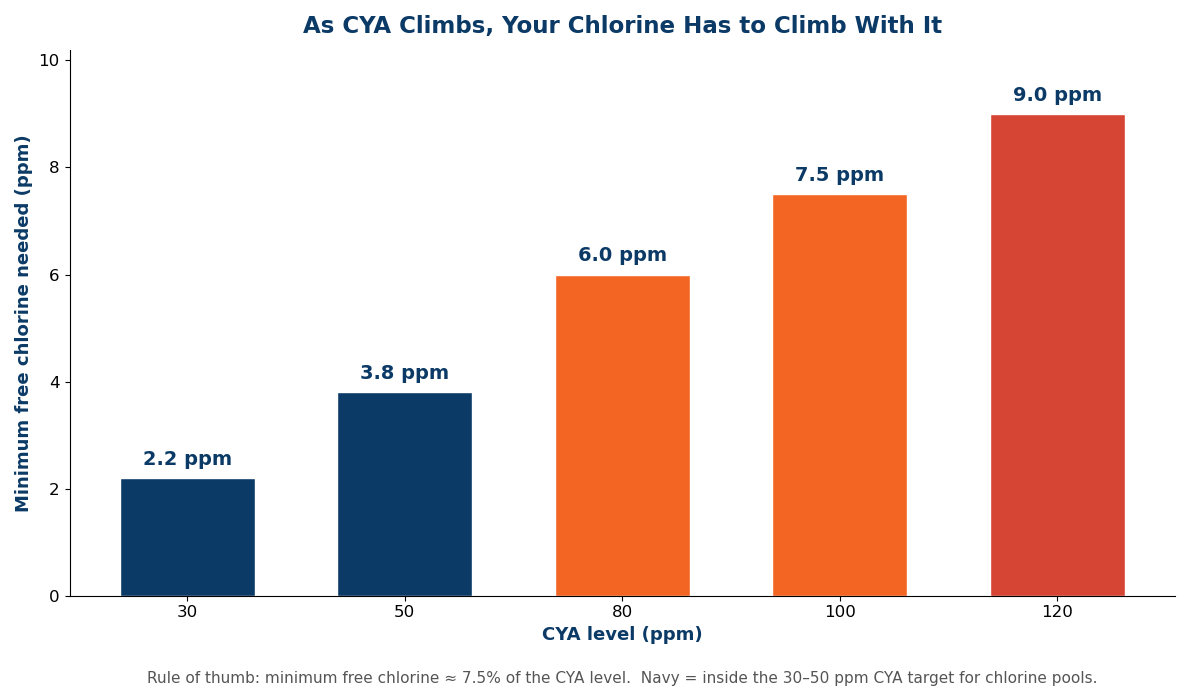
See the problem? The higher CYA climbs, the more chlorine you need for the same protection. At some point, bringing CYA down makes more sense than chasing it. There is only one way to do that.
Why does CYA keep creeping up?
Most of the time, nobody added CYA on purpose. It came in with the chlorine, one dose at a time. The two most common forms of solid chlorine both carry CYA:
- Trichlor — the pucks or tablets in a floater or an in-line feeder. Every puck adds chlorine and CYA.
- Dichlor — the granular chlorine a lot of people use to shock or dose. Every dose adds chlorine and CYA.
The chlorine gets used up. The CYA does not. It stays. So a puck-fed pool climbs all season. A pool that started at 40 can be at 90, 110, higher by late summer. It just crept — which is why I watch how a pool is chlorinated, not just today’s reading.
How do you lower CYA in a pool?
Here is the hard truth. CYA does not break down. It does not evaporate. It does not filter out.
The only way down is dilution. Take some water out. Put fresh water in. The fresh water has no CYA, so the mix reads lower. A partial drain and refill.

And repeated partial drains beat one big one. Smaller drains get you there with less risk, and you test between steps and stop when you land in range.
Say CYA is at 110 and your target is 40 to 50. Drain partway. Refill. Circulate. Retest. Repeat if needed. Slower, yes. Controlled, also yes.
No chemical removes CYA. Dilution is the fix.
How do you test CYA?
CYA is the awkward one to test. The standard home method is a turbidity test — turbidity just means cloudiness.
You mix your sample with a reagent, and it turns cloudy in proportion to the CYA. You pour it into a tube with a black dot at the bottom, until you cannot see the dot. The level when the dot disappears is your reading.
It works, but two people can read the same tube differently.

Test strips are worse. Strips are unreliable for CYA, and being wrong by 30 or 40 points changes the whole plan. Do not build a drain decision off a strip.
I read CYA digitally, on the full LaMotte SpinTouch panel. A number, logged, that I can compare against the last panel.
A worked example: chlorine at zero, CYA at 12
I see a version of this every summer.
Sunny pool, out in the open. The homeowner keeps adding chlorine and it keeps crashing to zero. I test. Chlorine, basically zero. Stabilizer is at 12.
Well basically what is happening is there is not enough CYA. Twelve is well below the 30 to 50 range. So any chlorine in there was getting burned up by the sun.
So what we need to do is get the organics out first — leaves eat chlorine too. Then balance the water in all its parameters, get CYA up to its proper level, and dose chlorine.
Once CYA is at that proper level, we should see that chlorine start to hold over the week. That is how you know the fix worked. Shock it and leave CYA at 12, and you are back to zero. Same sun. Same result.
What are the most common CYA mistakes?
“Just add more chlorine”
If CYA is too low, more chlorine just burns off faster than you can add it. If CYA is too high, you are fighting that 7.5% rule of thumb uphill. Either way, CYA is the root problem. Test it before you keep dosing.
“Shock fixes high CYA”
No. Shock is chlorine. It does not remove CYA. And if that shock is dichlor, it just added more CYA. Shock kills algae. Lowering CYA is not its job. Dilution is.
“CYA doesn’t matter in a salt pool”
It matters more, not less. Too low, and the cell runs longer and harder to keep up with what the sun burns off. Too high, and you get the same sluggish chlorine as any other pool. The cell makes chlorine. It does not manage CYA.
One more: guessing. CYA moves slowly, so people assume it is where it was last season. Test it. It probably is not.
How does El Dorado Pool Cleaning handle CYA?
CYA is part of the full 10-factor LaMotte SpinTouch panel, which runs once every 6 weeks — free and total chlorine, bromine, pH, calcium hardness, total alkalinity, CYA, copper, iron, and phosphate. Salt I read with a separate digital meter.
Weekly visits are different, and I want to be clear about that. Weekly, I test chlorine or bromine, pH, and total alkalinity. I do not run the full panel every week, and I will not claim I do.
That cadence fits CYA. It moves slow. It needs an accurate number on a regular cycle, tracked over time, so creep shows up before it becomes a drain.
You get the readings in your Pool Health Record — what I found, what I added, and why. That tracking is part of every plan on our weekly pool service — Essential Care at $110 a month, Signature Care at $175 a month, Premier Care at $225 a month.

Companion post: Calcium Hardness Explained — the other slow number.
When should you call a pro about CYA?
Call when you hit one of these:
- Your chlorine will not hold more than a day or two, and you do not know your CYA.
- Your CYA tests over 80 to 100 and you are not sure how much water to change.
- Algae keeps coming back at chlorine readings that should prevent it.
- You have been on pucks for seasons and CYA has never been checked.
- You are about to drain. Get the plan right before the water comes out.
A drain is not complicated, but it is not free — water out, water in, re-balance after. Confirm the number first and do the dilution in steps, once, instead of guessing and doing it twice.
Frequently asked questions about CYA
What is a good CYA level for my pool?
Chlorine pool, 30 to 50 ppm. Salt pool, 60 to 80 ppm. Inside those ranges, chlorine is protected from sun without getting sluggish.
Can CYA get too high from chlorine tablets?
Yes. That is the most common way it happens. Trichlor pucks add CYA with every puck, and dichlor adds it with every dose. The chlorine gets used up, the CYA stays, and it creeps up all season.
How do I bring CYA down?
Only one way: dilution. Partial drain and refill, in steps, testing between steps. No chemical removes CYA.
Why does my chlorine keep going to zero?
Most often, CYA is too low, so the sun burns chlorine off before it can hold. If CYA is around 10 or 15, that is likely your answer. Get CYA into range, balance the rest, then dose chlorine.
Does a salt pool need CYA?
Yes. A salt pool is a chlorine pool — the cell makes chlorine from salt. That chlorine needs sun protection, which is why salt pools run 60 to 80 ppm.
Do you check CYA in Cameron Park?
Yes. Cameron Park is on our weekly route. CYA is part of the full 10-factor panel every 6 weeks, and on a puck-fed pool it gets watched closer than that, because around here it only climbs.
That is CYA. One number. Sunscreen for your chlorine. Too little and nothing holds. Too much and nothing works fast enough.
If your chlorine will not hold, do not just add more chlorine. Get the CYA number, and get an accurate one. That is where the answer usually is.
— Brian Pounds, El Dorado Pool Cleaning. We show up.